

Goals
- Reduce media waste
- Improve user understanding
- Increase targeting precision and CTR
- Drive higher-quality website traffic
- Establish independence from third-party data and external platforms
At a time when digital advertising is steadily losing access to third-party data, most brands are adapting to these new limitations. Peugeot Slovenia has chosen a different path. In collaboration with iPROM, the company implemented an advertising system built entirely on first-party data. In doing so, it not only addressed regulatory and technological changes, but also laid the foundation for a more efficient and sustainable digital advertising model.
The results clearly validate this approach: media waste was reduced by 27%, website traffic increased by 34%, and CTR increased by 22%.
The challenge of underutilized data potential
For years, digital advertising has relied heavily on third-party data. While this approach enabled relatively precise targeting, it also created a strong dependency on external platforms and intermediaries.
Peugeot Slovenia, however, had access to something even more valuable: its own first-party data, collected through direct interactions with users. Every website visit, each interaction in the configurator, every submitted form, and every chatbot conversation represents a meaningful signal. The challenge was that these data points were often disconnected. They existed in silos and, therefore, did not deliver their full value.
The key question was no longer how to acquire more data, but how to better understand and activate the data the brand already had.
Strategic objectives Peugeot team wanted to acchive
Before redesigning the system in early 2025, Peugeot Slovenia clearly defined its ambitions. The goal was not just to improve individual metrics but to fundamentally enhance the efficiency and relevance of its digital advertising approach.
Objectives:
• Reduce media waste
• Improve user understanding
• Increase targeting precision and CTR
• Drive higher-quality website traffic
• Establish independence from third-party data and external platforms
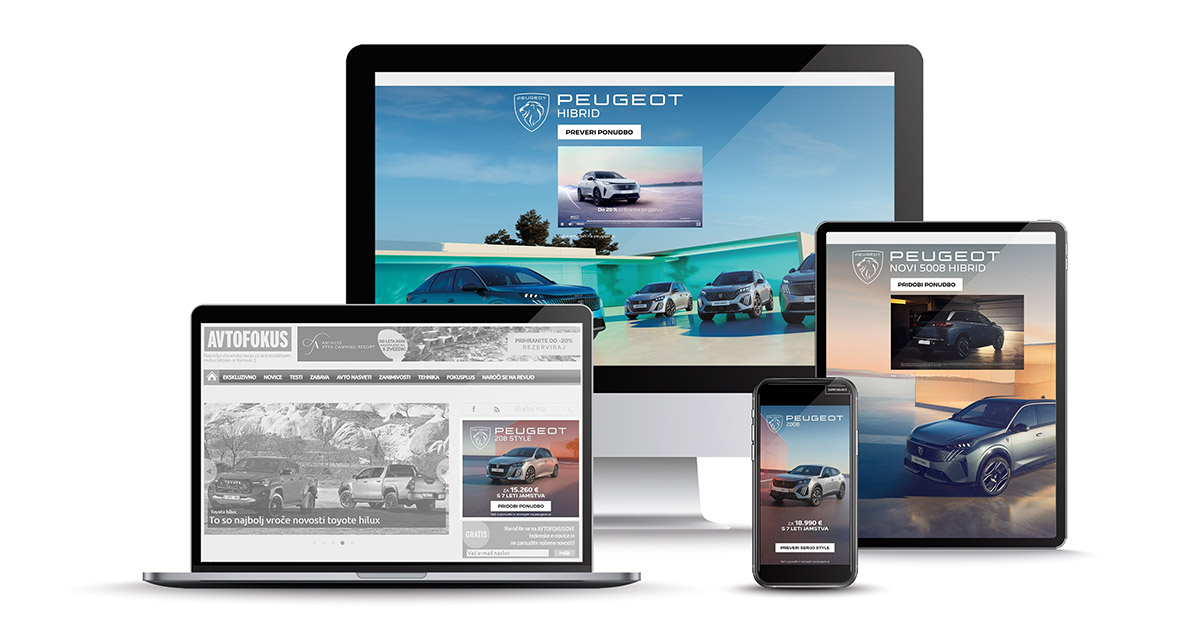
Unifying data into a single ecosystem
In partnership with iPROM, Peugeot Slovenia implemented a system built on iPROM Private DMP, integrating all existing data sources into a unified data ecosystem. This included behavioural data from websites, configurator interactions, CRM records, and AI chatbot interactions.
The system was not designed merely for data storage. Its core function was to learn from the data. Advanced algorithms analysed user behaviour patterns and identified purchase intent signals. Based on these insights, precise microsegments were created, enabling a significantly deeper understanding of users. Rather than broad audience groups, the system provided visibility into individual users and their positions within the decision-making journey.
Real-time personalization of communication
Building on these insights, the system started adapting advertising messages in real time. Users were no longer exposed to generic ads, but instead received content directly aligned with their interests and behaviour.
For example, a user exploring a family SUV would receive messages highlighting the benefits of that specific model. In moments of hesitation, the system provided additional information, answers, or a test drive offer.
Advertising thus evolved from an interruption into a relevant and timely response.
An always-on advertising platform that understands users
The solution was designed as an always-on advertising infrastructure, continuously adapting to user behaviour.
The system continuously optimized who should see an ad, which message to deliver, and where to deliver it. It also targeted users with similar behavioural patterns, based on large-scale data from the Slovenian digital ecosystem.
Importantly, the entire model operated independently of closed digital advertising platforms. This enabled greater data control, as well as enhanced flexibility. By integrating iPROM Private DMP, Peugeot Slovenia also ensured that its data remained protected from competitors.
Impact and results
The transition to a first-party data-driven advertising model, supported by a proprietary technology infrastructure, proved highly effective.
Key results:
• 27% reduction in media waste
• 34% increase in website traffic
• 22% higher CTR
• Increased user engagement and response rates
“With this approach, Peugeot Slovenia has become one of the first companies in the region to fully transition to a first-party data-driven advertising strategy. The key advantage of this model is that it is based on real user behaviour, enabling far more relevant and effective communication. At the same time, it provides brands with greater data control and long-term independence from external platforms,”emphasizes Gregor Draksler, Director of Advertising and Marketing at P Automobil Import d. o. o., Emil Frey Group.