

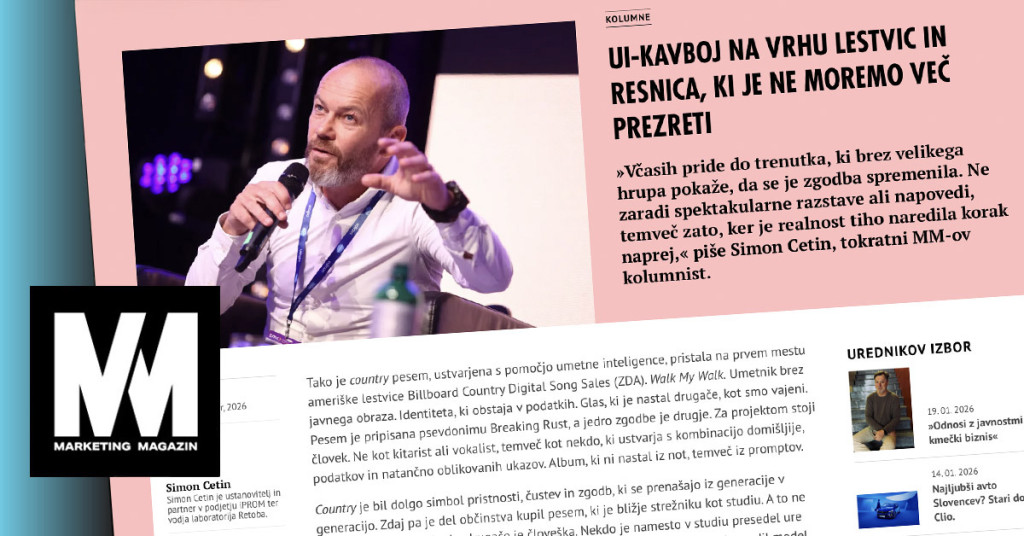
“Sometimes a moment comes along that quietly shows the story has changed – not because of a spectacular exhibition or a major announcement, but because reality has silently taken a step forward,” writes Simon Cetin, partner in PROM and founder of Retoba lab, in his column for Marketing magazine.
That is how a country song created with the help of artificial intelligence landed at the top of the Billboard Country Digital Song Sales chart in the United States. Walk My Walk. An artist without a public face. An identity that exists only in data. A voice created in a way we are not used to. The song is credited to the pseudonym Breaking Rust, but the heart of the story lies elsewhere. Behind the project stands a human. Not as a guitarist or a vocalist, but as someone who creates through a combination of imagination, data, and carefully crafted prompts. An album born not from musical notes but from prompts.
Country music has long been a symbol of authenticity, emotion, and stories passed down from generation to generation. Now, however, part of the audience has purchased a song that is closer to a server rack than to a studio. But that does not mean it isn’t human. It is simply human in a different way. Someone spent hours in front of a screen instead of in a studio, searching for a sound they previously couldn’t create. This project was not built by an AI model alone. It was built by a combination of a human who knows what they want to say and a tool capable of translating that intent into sound. That human captured the essence precisely enough for the market to respond with purchases.
This is no longer a question of who creativity belongs to. Artificial intelligence understands structure, aesthetics, and mood, but its direction is still set by a human. The audience accepts the result even when it doesn’t know who stands behind it. Culture is changing faster than we are willing to admit, yet in this shift, humans still holds the wheel. They just turn it differently.
When I experimented with prompts over a weekend two years ago and created my first song using artificial intelligence, I listened to it at least thirty times. Not because it was algorithmic, but because it matched my taste exactly. It was custom for my ears. As a teenager, I sometimes waited months for a song I truly liked, sitting by the radio tuned to Val 202 every Monday evening, hoping Stojan Auer would play it on the show Popular Twenty. Today, I can create such a song myself. Not from notes. From prompts, ideas, and curiosity.
When a guided AI model can sketch a voice, an identity, and a melody in a matter of minutes, the role of the creator changes. It is no longer just about talent in the traditional sense. It is about the ability to design, guide, and curate. It is about knowing how to extract something truly your own from technology. An industry built on personal stories will have to accept a competitor that doesn’t tire, doesn’t hesitate, and knows no production limits. Yet the human behind such projects is still there. Only the tools are new.
Walk My Walk is not just a song at the top of the chart. It is a signal that a generation of creators is emerging who do not hold guitars, but keyboards. Who do not record in studios, but in models. Who do not search for notes and craft prompts instead. This is not a replacement for people. It is their evolution.
The AI cowboy has mounted the horse and reached the top. Now we must ask ourselves whether it bothers us that we cannot invite him onto the stage, or whether it bothers us more that a prompt engineer, guided by a vision, created something that until yesterday was reserved for a team of musicians, producers, and an entire studio – and did so without a single night on tour.
This column was originally published in January 2026 print edition of Marketing magazin Nr. 535-536.