

At the Marketing Summit Ljubljana, organized by Instore Slovenia and held on April 2, Miloš Suša, Director of iPROM, and Andraž Zorko, Partner and Co-founder of Valicon, explained why understanding digital advertising effectiveness requires moving beyond click-based metrics and focusing on the actual impact ads have on users.
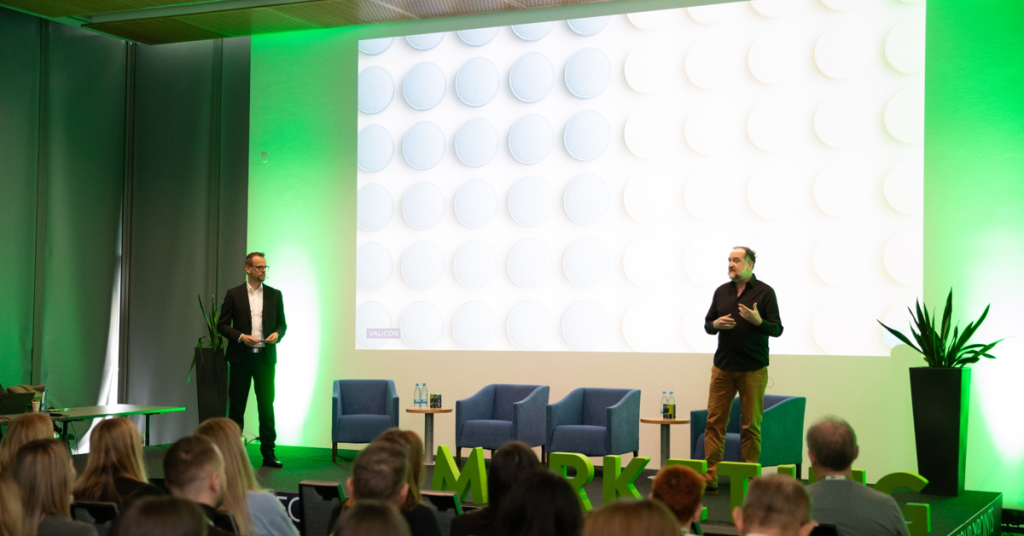
In his opening remarks, Miloš Suša highlighted a fundamental challenge of modern digital advertising: despite its high measurability, we still struggle to clearly answer how much advertising truly contributes to sales. He emphasized that digital metrics such as impressions, clicks, and reach often fail to reflect real user impact, as most of the effect occurs without direct interaction.
He pointed out that approximately 99% of ad impressions receive no clicks—yet this does not mean they have no impact. On the contrary, these impressions significantly influence brand perception, ad recall, and purchase intent, but are often overlooked due to inadequate measurement approaches.
The presentation therefore focused on the Brand Lift measurement approach, based on an experimental methodology using test and control groups. One part of the target audience is exposed to ads, while another is not. Both groups are then asked the same questions in real time. The difference in responses represents the actual impact of advertising, isolating effects that would have occurred regardless of the campaign.
Through real-world examples, the speakers demonstrated that digital campaigns can measurably increase ad recall, improve brand perception, and lift purchase intent—while also enabling the calculation of cost per achieved outcome. This type of metric provides a much more direct connection between advertising activities and business results.
Andraž Zorko further emphasized the importance of understanding how advertising effects build over time and with repeated exposure. He noted that impact does not occur at the first contact, but only after a certain frequency of exposure. Initial effects appear at lower frequencies, while the strongest results often emerge after multiple touchpoints.
He also introduced the concept of the saturation point, where additional exposure no longer delivers positive effects and may even diminish them. This means that each campaign requires defining an optimal frequency that maximizes impact while avoiding overexposure.
»Digital advertising is the most measurable advertising channel, yet we still too often measure only what happens after the click.« Miloš Suša, director of iPROM
»A click is not a prerequisite for impact. An ad can influence recall, brand perception, and purchase intent even when the user does not click on it.« Andraž Zorko, Partner and Co-founder of Valicon