


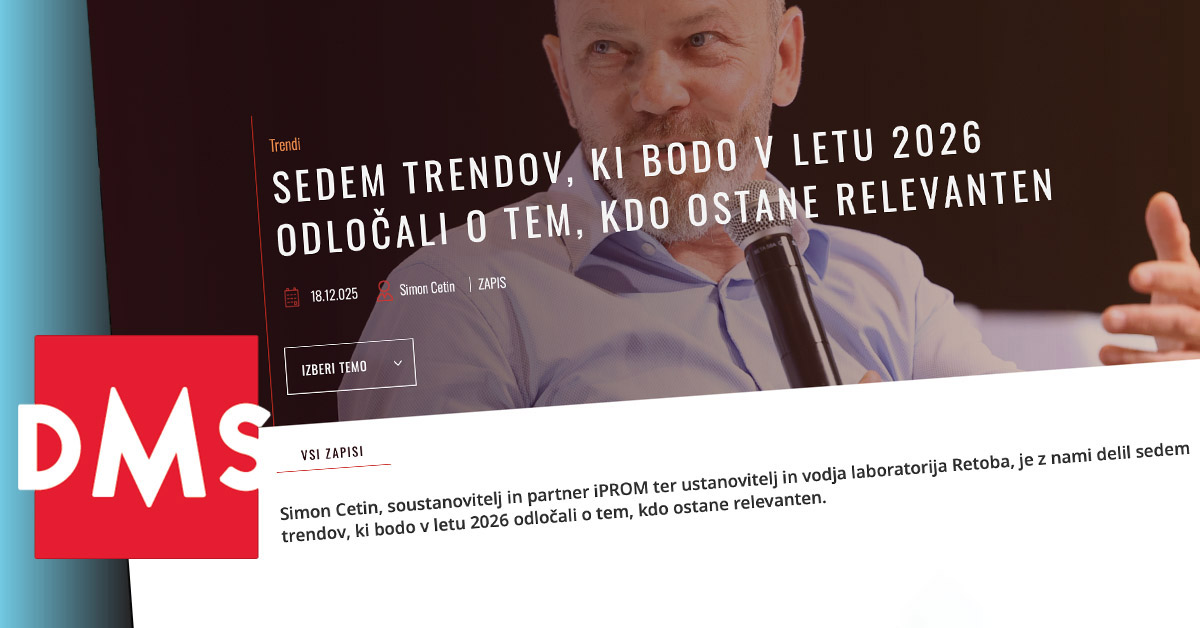
Simon Cetin, Partner at iPROM and Founder and Head of the Retoba Laboratory, has outlined seven key trends for the Slovenian Marketing Association that will decisively shape marketing, brand building, and product development in 2026. His analysis is grounded in shifts in human behaviour and decision-making, changes that have been accelerated in recent years by artificial intelligence. He emphasises that 2026 will not be a turning point because of new tools, but because of a deeper understanding of how people now make decisions: a move away from traditional information search toward the expectation of immediate, clear answers; the growing importance of explainability as a competitive advantage; and the central role of first-party data as the fuel for the effective use of artificial intelligence.
If you stay in business long enough, you begin to see at technology differently. You become less interested in what is new and more focused on what has genuinely changed in people’s behaviour and how they make decisions.
With artificial intelligence, that change is already underway. Not in laboratories, but in everyday life. People are tired of browsing, comparing and pushing their way through informational noise. What they want is clarity: fast, simple and without unnecessary steps.
2026 will be the year when the consequences of this shift become clearly visible in marketing, product development and brand building. It will also be the year when the lessons of recent years are turned into new foundations for the future.
1. For twenty years we searched. Today we ask.
For two decades, the default instinct was “search”. Today, it is “ask”. People no longer return to lists of links or manually compare information. They ask a question, read the answer and move straight on to a decision.
ChatGPT, Perplexity, Claude, Gemini, Google AI Overviews, Grok and similar conversational interfaces have shifted the moment of decision. Increasingly, the first impression, the first explanation and the first choice occur before people even reach a website. This changes the role of websites, advertising, communication and content. It does not eliminate them, but it does move the centre of gravity.
2. Visibility in AI is becoming a new dimension of brand competitiveness
When we examine how conversational systems understand brands, companies and their products and services, the same pattern keeps emerging. The most visible brands are not necessarily the biggest ones; they are the ones that are easiest to understand.
A brand is no longer only what a company says about itself. A brand is what a certain system is able to explain about it to others.
This is the uncomfortable but crucial part. If AI includes your brand in vague terms only, you become interchangeable. If it describes your product or service incorrectly, you lose before you ever get a chance to compete. And if you are absent from the answer altogether, then for all practical purposes, you do not exist.
3. Digital ambassadors are becoming a core part of product and service experiences
In sectors such as food, energy, mobility and public services, we can clearly see a shift in user behaviour. Why browse a company website, search for documents and compare information when you can simply ask a question and receive a clear answer or direction that saves time, simplifies the decision and helps you move forward?
This is where digital ambassadors become the logical next step. Not as a fashionable add-on or a button on a website, but as an element that complements the product experience and increases user value. Websites remain important, but conversation is becoming the shortest path to clarity.
4. First-party data is becoming the strategic fuel for AI
As third-party data loses value, what remains is the most authentic signal of all: what people say themselves. Their questions, doubts, reasons for hesitation and the language they use to describe their problems.
When we combine this with known behavioural patterns – what we look at, where we pause, what we return to and where we drop off – we gain a broader and more meaningful picture.
This is first-party signal from the real world. In the age of artificial intelligence, it is fuel. Those who know how to collect it, understand it and use it intelligently can deliver a vastly different quality of experience. At this point, AI is no longer being a generic assistant and becomes relevant, personalised support.
5. Products are no longer designed only for use, but also for explanation
In 2026, it will no longer be enough for a product to be good. It will need to be explainable. Not only to sales teams and marketing departments, but also to the artificial intelligence that compares products, positions them among alternatives and recommends them at the right moment.
The biggest mistake is assuming that AI will understand on its own. It will understand what is clearly described, consistently named, precisely structured and connected to concrete use cases. Businesses that ensure their product is explainable within systems that deliver answers will be chosen more often – sometimes before competitors even enter the conversation.
6. Once technology removes noise, the human element comes to the fore
When AI takes over routine tasks, shortens the path to information and removes repetition, something profoundly human emerges. People gain space – for thinking, judgement and relationships.
AI does not take away the human role. It takes away the noise. And when the noise disappears, judgement, values, tone and leadership style become far more visible. This is where teams differ. This is where brands truly distinguish themselves.
7. Algorithms are becoming the “shepherds” of attention and opinion
This is a trend we cannot ignore. Over the past decade, we have seen how algorithms can influence public sentiment. Political campaigns, polarisation, and even Brexit marked a moment when it became clear that the digital information environment is not neutral.
Compared with conversational interfaces, social media remains in its infancy. It operates by pushing content, not by explaining it. Conversational systems, however, often become the answer itself – the explanation and the framework through which people understand the world.
This is where responsibility begins. If a system becomes a mediator of how the world is explained, then ethics is no longer an optional extra; it becomes part of the infrastructure. No one wants war, and no one wants a society torn apart by informational noise. I believe human reason will prevail – not automatically, but because as professionals, companies and individuals we will insist on ethics, responsibility, and common sense, and use technology in ways that foster understanding rather than promote conflict.
A new beginning
2026 will not be the year of tools. There will be enough tools for everyone. It will not be the year of technology, which is already mature enough to change the rules of the game. It will be the year of understanding: understanding that the path to decisions is moving into answers, that brands must be explainable, and that first-party signals constitute the core of relevance.
This is not a forecast of the future; it is a reality we can already see today. Let us wish each other good luck for 2026 – and courage for the years ahead.
The piece was originally published on the website of the Slovenian Marketing Association in an article titled “Seven trends that will determine who remains relevant in 2026“.